Which Toyota Land Cruiser Features Support Off-Road Driving?
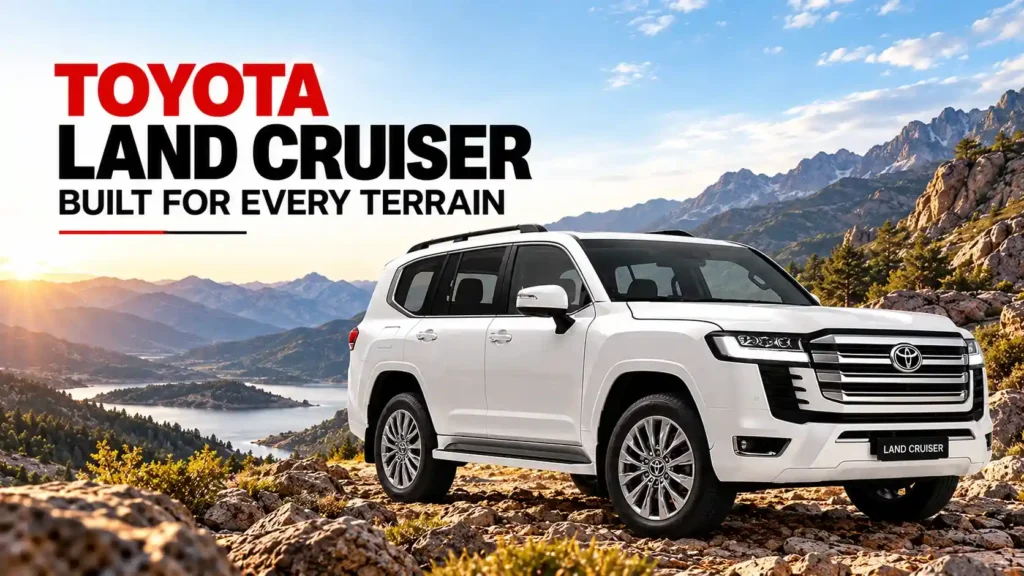
What happens when the smooth highway ends and the real adventure begins?
Rocky trails, steep climbs, muddy tracks and unpredictable terrain put every SUV’s capabilities to the test. While a powerful engine helps, true off-road performance depends on how confidently a vehicle handles obstacles, maintains traction and adapts to changing conditions.
The Toyota Land Cruiser combines powerful performance, advanced four-wheel-drive technology and a robust body structure to handle demanding driving conditions. Its off-road features work together to improve traction, support vehicle stability and help drivers navigate challenging terrain with greater confidence.
What Makes the Toyota Land Cruiser Suitable for Off-Road Driving?
The Toyota Land Cruiser 300 combines a durable body-on-frame construction with a powerful engine, full-time four-wheel drive and advanced terrain management technologies.
Its engineering focuses on maintaining traction, improving vehicle control and supporting performance across different driving surfaces.
The Land Cruiser provides several features that help drivers handle changing terrain from rocky mountain routes to loose gravel and muddy trails.
Find below important Toyota Land Cruiser features that support off-road driving.
1. Full-Time Four-Wheel Drive for Better Traction
The Toyota Land Cruiser uses a full-time four-wheel-drive system that distributes engine power between the front and rear wheels.
Unlike a conventional two-wheel-drive vehicle, this system allows all four wheels to contribute to traction.
Maintaining sufficient grip becomes particularly important when you drive on loose gravel, muddy roads or uneven surfaces.
The four-wheel-drive system helps the vehicle transfer power to the road more effectively and supports controlled movement across challenging terrain.
Full-time four-wheel drive also supports stability when road surfaces change unexpectedly.
However, available traction still depends on tyre condition, terrain and driving technique.
2. Multi-Terrain Select for Different Driving Conditions
Different off-road surfaces require different driving responses.
A vehicle travelling over loose sand may need different traction management than one navigating rocky ground or muddy trails.
The Toyota Land Cruiser addresses these requirements through its Multi-Terrain Select system.
This technology allows drivers to select suitable terrain settings based on the driving conditions.
Depending on the selected mode, the system adjusts relevant vehicle controls to help manage traction and wheel slip.
Multi-Terrain Select supports driving across conditions such as:
- Muddy trails
- Loose sand
- Rocky surfaces
- Dirt and gravel roads
- Uneven off-road tracks
The exact modes and their availability depend on the vehicle specification.
3. Crawl Control for Difficult Off-Road Sections
Driving across steep, rocky or highly uneven terrain often requires careful control of vehicle speed.
Frequent accelerator and brake adjustments can make these situations more demanding.
The Toyota Land Cruiser offers Crawl Control, a low-speed off-road assistance system designed to help maintain a controlled pace over challenging surfaces.
When activated under suitable conditions, Crawl Control manages engine output and braking to maintain a selected low speed.
This allows the driver to concentrate more on steering and choosing a safe path.
Crawl Control can also assist when travelling across deeply rutted tracks or other difficult off-road sections.
The system does not replace careful driving or proper route assessment, but it can reduce the effort involved in maintaining a consistent low speed.
4. Multi-Terrain Monitor for Improved Visibility
One of the biggest challenges during off-road driving is identifying obstacles that may not be clearly visible from the driver’s seat.
Large rocks, deep ruts and uneven ground can make it difficult to judge the vehicle’s immediate surroundings.
The Toyota Land Cruiser’s Multi-Terrain Monitor helps address this challenge by displaying camera views of the area around the vehicle.
Depending on the selected view and equipment, the system can help drivers observe obstacles near the front, sides or rear.
It can also assist when manoeuvring through confined spaces or approaching uneven ground.
The system improves situational awareness, although drivers should still check their surroundings directly and use appropriate guidance when necessary.
For a large SUV like the Land Cruiser, this technology adds practical convenience during demanding off-road manoeuvres.
5. Robust Body-on-Frame Construction for Durability
The Toyota Land Cruiser uses a body-on-frame construction designed to support strength and durability.
Unlike many SUVs that use a unibody structure, the Land Cruiser features a separate frame that supports its body and major mechanical components.
This construction suits a vehicle designed for demanding terrain and challenging driving conditions.
The Land Cruiser 300 uses Toyota’s GA-F platform, which combines a robust structure with engineering improvements intended to reduce weight and improve overall vehicle performance.
A strong frame supports the vehicle when travelling across uneven surfaces that place different loads on the wheels and suspension.
The Land Cruiser’s construction helps it handle these demanding situations while maintaining its focus on passenger comfort and vehicle durability.
6. High Ground Clearance for Uneven Terrain
Ground clearance plays an important role in off-road driving because it determines how much space exists between the vehicle’s underside and the ground.
When navigating rocky trails, deep ruts or uneven tracks, sufficient ground clearance helps reduce the risk of underbody contact.
The Toyota Land Cruiser’s off-road-oriented design provides clearance suitable for tackling a variety of challenging surfaces.
This becomes useful when travelling across raised obstacles, uneven mountain roads or deeply worn tracks.
However, ground clearance alone does not determine whether a vehicle can safely cross an obstacle.
Approach angle, departure angle, breakover angle, suspension movement and tyre condition also influence off-road performance.
Drivers should assess the terrain carefully and avoid obstacles that exceed the vehicle’s capabilities.
7. Powerful Twin-Turbo Diesel Engine for Demanding Terrain
Off-road driving often requires strong pulling power at relatively low speeds.
The Toyota Land Cruiser 300 features a 3.3-litre V6 twin-turbo diesel engine paired with a 10-speed automatic transmission.
The engine produces approximately 309 PS of power and 700 Nm of torque, giving the SUV substantial pulling capability.
Strong torque helps the vehicle maintain controlled progress when navigating inclines and demanding terrain.
The automatic transmission also helps manage power delivery across different driving conditions.
The engine and transmission provide the performance needed for highway journeys and challenging off-road adventures.
8. Low-Range Gearing for Steep Climbs and Descents
Certain off-road situations require more controlled movement than ordinary driving conditions.
Steep climbs, rocky trails and difficult descents often demand strong wheel torque at low vehicle speeds.
The Toyota Land Cruiser’s four-wheel-drive system includes low-range gearing to support these requirements.
Low-range gearing changes the drivetrain’s effective gear ratio, allowing the vehicle to deliver greater torque multiplication at the wheels while moving slowly.
It also supports low-speed control during difficult descents.
This feature becomes particularly useful when combined with the Land Cruiser’s other off-road technologies.
Drivers should select low-range gearing only under appropriate conditions and follow the vehicle’s operating instructions.
9. Differential Locking and Traction Management
Off-road surfaces rarely provide equal traction to every wheel.
One wheel may rest on firm ground while another encounters loose gravel, mud or an uneven obstacle.
In these situations, effective traction management helps the vehicle maintain movement.
The Toyota Land Cruiser combines its four-wheel-drive system with electronic traction management and differential-locking capabilities, depending on the model specification.
A differential lock helps limit the difference in rotational speed between connected wheels or axles, improving the ability to transfer usable drive when traction varies.
Electronic traction systems can also apply braking intervention to help manage wheel slip.
These technologies support the Land Cruiser’s ability to navigate uneven and low-grip surfaces.
However, the exact differential-locking equipment varies by variant and market, so buyers should confirm the specification of their preferred model.
10. Advanced Suspension for Stability and Comfort
Off-road driving exposes a vehicle to uneven surfaces, sudden changes in wheel position and repeated impacts.
A capable suspension system helps the wheels maintain contact with the ground while reducing the transfer of road disturbances into the cabin.
The Toyota Land Cruiser features a suspension setup engineered to balance off-road capability with passenger comfort.
Its front suspension uses a double-wishbone arrangement, while the rear employs a rigid axle with a multi-link configuration.
This combination supports durability and wheel control when travelling across challenging terrain.
The suspension helps manage vehicle movement on rocky tracks, uneven roads and other demanding surfaces.
The Land Cruiser also combines its suspension engineering with electronic stability and traction systems to support vehicle control.
How Does the Toyota Land Cruiser Combine Off-Road Capability with Luxury?
The Toyota Land Cruiser offers more than specialised off-road technology. It also provides a premium cabin designed to make long journeys comfortable.
Its spacious seating, refined interior materials, advanced infotainment features and climate control system help passengers enjoy extended trips.
The powerful diesel engine and automatic transmission support comfortable highway cruising, while the four-wheel-drive system and terrain technologies prepare the vehicle for more challenging routes.
The Land Cruiser’s combination of performance, comfort and off-road assistance makes it suitable for buyers who want a luxury SUV with genuine adventure capability.
Visit Galaxy Toyota Land Cruiser showroom to find out the Toyota Land Cruiser price Delhi.
Frequently Asked Questions
1. Is the Toyota Land Cruiser suitable for off-road driving?
Yes, the Toyota Land Cruiser is designed to handle demanding off-road conditions. Its full-time four-wheel-drive system, low-range gearing, Multi-Terrain Select, Crawl Control and robust body-on-frame construction support driving across uneven, rocky and low-grip surfaces. Drivers should still assess terrain conditions and follow appropriate off-road driving practices.
2. What is Multi-Terrain Select in the Toyota Land Cruiser?
Multi-Terrain Select allows drivers to choose suitable settings for different off-road surfaces. The system adjusts relevant vehicle controls to help manage traction and wheel slip. It supports more controlled driving on challenging terrain such as mud, gravel and rocky tracks.
3. How does Crawl Control help during off-road driving?
Crawl Control helps the Toyota Land Cruiser maintain a selected low speed on challenging terrain by managing engine output and braking. This reduces the need for frequent accelerator and brake adjustments, allowing the driver to concentrate on steering. The feature can be particularly useful on steep or rocky sections.
4. Does the Toyota Land Cruiser have four-wheel drive?
Yes, the Toyota Land Cruiser 300 features a full-time four-wheel-drive system. It helps distribute engine power between the front and rear wheels to support traction across different driving surfaces. The vehicle also offers low-range gearing and additional off-road assistance technologies for demanding driving conditions.
5. Is the Toyota Land Cruiser comfortable for long-distance journeys?
Yes, the Toyota Land Cruiser combines off-road capability with a premium interior, spacious seating, advanced comfort features and a powerful diesel engine. Its suspension and automatic transmission support comfortable highway travel, while its four-wheel-drive technologies help when routes become challenging. This makes it suitable for long-distance journeys and outdoor adventures.
Explore the Toyota Land Cruiser at Galaxy Toyota
Explore the Toyota Land Cruiser’s features, available specifications and ownership options at Galaxy Toyota. Our team can help you understand its off-road technologies, premium features, latest Toyota Land Cruiser price in Delhi and applicable finance options.
Visit Galaxy Toyota to test drive the Toyota Land Cruiser.